Description
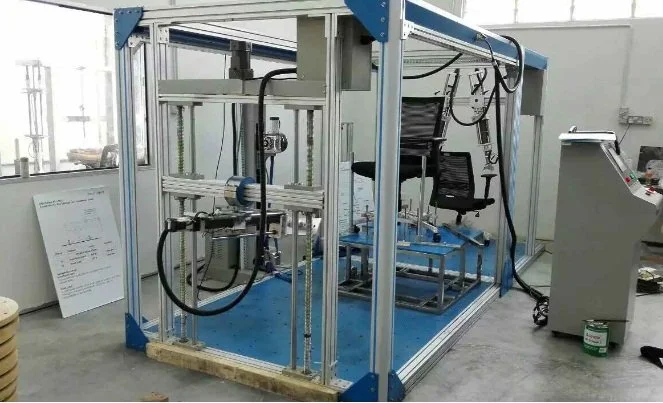
Furniture Comprehensive Testing Equipment
1 Purpose
Furniture Comprehensive Testing Equipment is simulated in everyday conditions , inspection rocking chair bearing durability . The test will be a certain shape , quality of load modules , placed on the seat in the rear seat back repeatedly push and pull action until after a certain number of test bearing conditions , this test can always conducive to improved product mix , eliminating potential quality problems , improve product durability and reliability .
2 , the principle
Rocking chair with a seat surface shaped back position , the weight of the horizontal load of the module to load in the form of the predetermined frequency repetitive load movement
Testing standards:
According to EN 1335-3,EN 581 2,EN 1728, BIFMA X5.1,can do chair bending durability test,According to EN 527-3 and EN 581-3,can do desk vertical and horizontal test, 5 action operator,it can do test automatically.
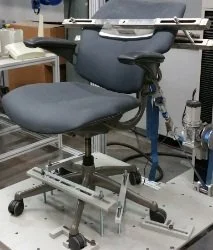
Sample:Chair,swivel chair,armchair,stool,rocking chair,desk.
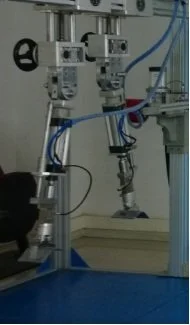
System configuration:Test table is used to interactive bending test:chair seat, back of chair,handrail and chair,and together with desk horizontal and vertical test.
– Central controller,provide 5 independent cylinder stator and controller.
– PC workstation,provide programmable,visualization and assess.
3 the main technical parameters
Swing amplitude 300 ~ 500mm
Calculator 0 ~ 999 , 999 times ( adjustable
Weights 10KG ( of 15 )
Maximum counterweight weight 150KG
Dimensions ( approx . ) ( L * W * H ) 1650 * 1300 * 2150mm
Power 3 ∮ , AC380V , 50Hz
En1728 , GB1728 , Bifma × 5 . 5
Chair back strength durability test
Chair leg strength test – forward / lateral loading
Pedals ( ring ) static load test – Vertical
Pedals ( ring ) endurance test
Handrails durability test equipment
Test items:
1. Seat Static Load Test: block some of the forces applied vertically downward by loading on the loading point for at least 10 seconds. And repeated 10 times.
2. The seat surface fatigue test: by loading pad, a number of provisions and 950N force is applied vertically downward repeated loading point on the seat surface. Loading rate of no more than 40 times per minute.
3. Impact test seat surface: a piece of foam on the seat surface, and then the seat surface impact placed a predetermined height, so that the free fall, shock loading site 10 times each.
Test Method seat back:
1. The seat back static load test: stopper chairs and stools feet. Then a predetermined load is applied to the balance of the seat loading point. Then a predetermined force in a direction perpendicular to the seat back by loading pad applied to the load point. For at least 10 seconds. And repeated 10 times.
2. The seat back fatigue test: stopper chair or stool feet, and then applying a vertical force of 950N on the seat surface mount points, and then loaded back block by the 330N force prescribed number of times applied to the back of the mount point. Loading rate of no more than 40 times per clock.
Test items: Seat Impact
Impact test of the seat surface: a piece of foam on the seat surface, and then the seat surface impact placed a predetermined height, so that the free fall, shock loading site 10 times each.
1 backrest static strength test 1 (Load function)
* Load 890 Newton (200 lbs) a minute without durability loss.
2 backrest static test 1 (standard load)
* Load 1334 Newton (300 lbs) a minute, did not result in a complete change in the structure of the main part.
Office chair Ipomoea compression testing machine
3 Ipomoea static testing
* To 11120 Newtons (2500 lbs) pressed for a minute, did not result in a complete change in the structure of the main part; then move the heavy weight and applied again for a minute. During re-applied, oil can not touch the core test platform. It did not result in changes in the main part of the complete structure.
4 dynamic impact test (function load)
* 4102KG (225 pounds) of body weight from 6 inches (152MM) height of free fall to the center of the seat, did not cause major structural changes. The highest position and lowest position each time point.
5 dynamic impact test (standard load)
* 136KG (300 pounds) of body weight from 6 inches (152MM) height of free fall to the center of the seat, did not cause major structural changes. The highest position and lowest position each time point.
6 rotating test
* Raised to the highest chair, load 102KG (225 lbs) after 360-degree rotation of 60,000 rpm, the chair to the lowest point, load 102KG (225 lbs) 360 degree rotation 60,000 rpm, resulting in no durability loss.
7 tilt mechanism fatigue testing
* Center of the seat load 102KG (225 lbs.) To 10-30 times / min speed, causing no structural durability loss tilting 300,000 cycles.
8 Shock Test
* 357KG (125 lbs) from 1 inch (25MM) did not result in higher durability loss free fall to seat 100,000 cycles after the impact.
9 seats forefoot fatigue testing
* Each seat rake load 734 N (165 lbs) did not cause durability loss after 20,000 cycles.
10 backward stability test
* Center of the seat load 79KG (173 lb), tipping force is applied to the chair back until the total weight was transferred to a back support, tipping force less than 89 N (20 lbs), “the first. II chair”
11 Forward stability test
* Chair casters 13MM barrier was blocking, impose downward from 60MM chair at the center of the leading edge 600 Newton force (135 lbs). In the absence of tilt, the seat should be able to withstand the force of 20 Newtons (4..5 lbs)
12 armrest vertical static strength test (function load) “designed lowest point”
* Re-applied force of 890 Newtons (200 lbs) for one minute, no durability loss. Vertical load were to 127MM (5 inches) long on the apparent weakest point. 13 armrest vertical static strength test (standard load) “point of use requirements”
* Load 1334 Newtons (300 lbs) a minute, did not cause major structural changes. Vertical load were to 127MM (5 inches) long to do the obvious weak point.
14 armrest level static strength test (function load)
* The level of the most forward point outward armrest load 445 N (100 lbs) one minute did not cause durability loss.
15 armrest level static strength test (standard load)
* The level of the most forward point outward armrest load 667 N (150 lbs) a minute without making major structural changes.
16 back fatigue test
* Center of the seat load 102KG (225 lbs.) Back to the central vertical urging 445 Newtons (100 lbs) 120 000 cycles without fatigue wear “applies only to typel”
Fatigue tests 17 castors
* Seat planting 102KG (225 lbs) across the hard surface three obstacles and there are no obstacles in the 2000 cycle of hard and soft surfaces 98000 cycles without fatigue wear. After 22 N (5 lbs) of thrust cycle test, casters should not be separated.
18 armrest fatigue test
* 10-degree angle from the urging 400 Newtons (90 lbs) to 60,000 cycles each armrest, no structural damage and fatigue wear.